Mesh
Every jail in Jailrun is more than an isolated sandbox — it is a globally unique network identity. Each jail holds its own cryptographic keypair and can be reached by a stable IPv6 address that belongs to it alone, regardless of where the host machine sits on the Internet.
Jailrun instances can pair with each other to form a private encrypted mesh. After pairing, every jail on one machine can reach every jail on the other, and vice versa. There is nothing to configure on a per-jail basis — it just works.
Why this matters
A few things this makes possible:
- Collaborate with a teammate while both of you work locally, then test integrations together in real time. Your jails see each other's jails as if they shared one environment.
- Connect a local app to a remote database running in a jail on another host — no tunnels, no port forwarding, no VPN setup.
- Span a dev environment across machines. Run your frontend locally and point it at a backend jail on a remote server. DNS names resolve, connections go through, firewalls stay tight.
How it works
Jailrun builds its mesh on top of Yggdrasil, an encrypted IPv6 overlay network. Every participant — the VM and each jail inside it — runs its own Yggdrasil node and gets a 200::/7 address derived from its public key. These addresses are permanent, globally unique, and not tied to any physical network.
flowchart LR
    subgraph hosta["Jailrun A (laptop behind NAT)"]
        JA1[Jail A1] --> VMA[VM A]
        JA2[Jail A2] --> VMA
    end

    subgraph hostb["Jailrun B (remote instance)"]
        VMB[VM B] --> JB1[Jail B1]
        VMB --> JB2[Jail B2]
    end

    VMA -->|encrypted| Relay{{Public relay}}
    Relay -->|encrypted| VMB
All traffic on this path is end-to-end encrypted between the two jails. The VMs and the relay route it, but cannot read it. The VM acts as a bootstrap node. It runs Yggdrasil on the jail bridge (10.17.89.1:19001) and peers with the public relay:
flowchart TB
    subgraph vm["VM (bootstrap node)"]
        YggHost["Yggdrasil host<br/><code>10.17.89.1:19001</code>"]
    end

    subgraph jails["Jails"]
        J1["jail α<br/>own keypair → own 200::/7 address"]
        J2["jail β<br/>own keypair → own 200::/7 address"]
        J3["jail γ<br/>own keypair → own 200::/7 address"]
    end

    J1 -->|tcp://10.17.89.1:19001| YggHost
    J2 -->|tcp://10.17.89.1:19001| YggHost
    J3 -->|tcp://10.17.89.1:19001| YggHost
    YggHost -->|tcp| Relay{{Public relay}}
The relay
Both machines need a common point to find each other. This is especially important when one or both are behind NAT, where direct connections are impossible without assistance.
The relay is a lightweight service with two jobs: it acts as a Yggdrasil peer so that nodes behind NAT can route traffic through it, and it exposes a small HTTP API that coordinates the pairing handshake. It does not store any long-lived state and never sees encryption keys.
Hypha, the company behind Jailrun, runs a free public relay at relay.jail.run that every Jailrun instance uses by default. You do not need to create an account or configure anything.
The relay is open source. You can run your own if you prefer full control over the handshake on your infrastructure, or implement a compatible relay from scratch — the API surface is three endpoints only.
Pairing
Pairing is how two Jailrun instances agree to let their jails talk to each other. It is a short handshake coordinated through the relay:
- One side creates a pairing with
jrun pair create. Jailrun collects the Yggdrasil address of every running jail and sends the roster to the relay, which returns a short code. - The other side joins with
jrun pair <code>. It sends its own jail roster to the relay and receives the first side's roster in return. - Both sides update their firewalls and DNS to allow and resolve the newly paired jails.
After pairing, each side knows the Yggdrasil addresses of the other's jails and opens the firewall for exactly those addresses — nothing more.
sequenceDiagram
    participant A as Jailrun A
    participant R as Relay
    participant B as Jailrun B

    A->>R: POST /pair {jails: A's roster}
    R-->>A: {code: "a1b2c3"}

    A->>R: GET /pair/a1b2c3
    R-->>A: {joined: false}

    Note over A: Keeps polling...

    B->>R: POST /pair/a1b2c3 {jails: B's roster}
    R-->>B: {jails: A's roster}

    A->>R: GET /pair/a1b2c3
    R-->>A: {joined: true, jails: B's roster}

    Note over R: Pairing consumed and deleted

    Note over A,B: Both sides update pf and DNS
Side A creates a pairing and receives a short code, then polls the relay waiting for someone to join. Side B posts its jail roster to the same code and immediately receives A's roster. On A's next poll, the relay returns B's roster and deletes the pairing — the code cannot be reused.
Identity
Each jail's Yggdrasil keypair is generated once, on first deploy, and persisted on disk. This means a jail's 200::/7 address is stable across restarts, redeploys, and reboots. Peers that have already paired with it do not need to re-pair.
Access control
Mesh traffic is blocked by default. Every jail runs its own instance of pf, and the default ruleset drops all inbound Yggdrasil traffic. Pairing is the only mechanism that opens the firewall, and it does so selectively — only the specific 200::/7 addresses exchanged during the handshake are whitelisted.
In short: if two Jailrun instances are not paired, their jails cannot reach each other over the mesh — even though they may share the same relay. The overlay network provides connectivity and pf provides the policy.
Example
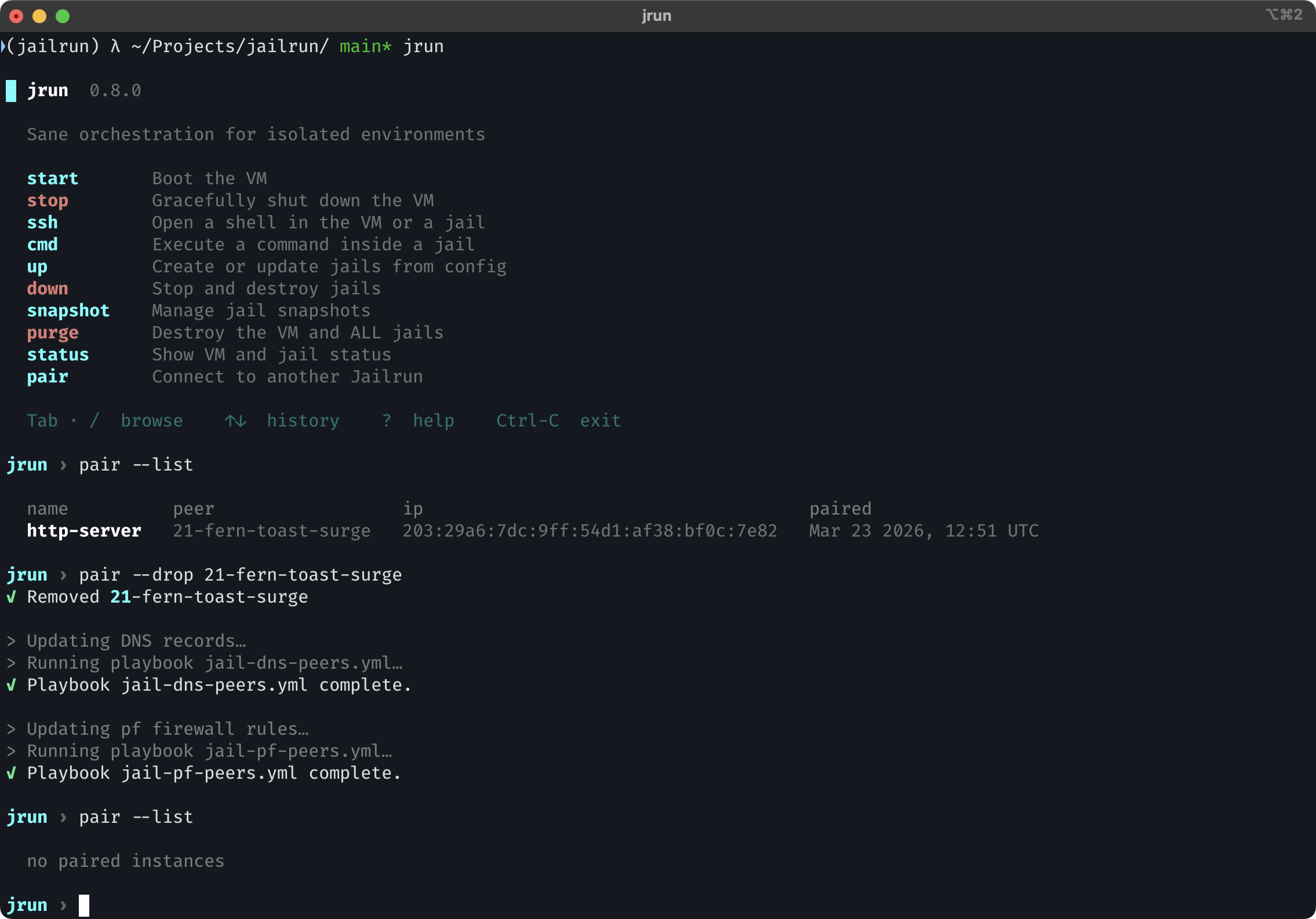
Two machines (a laptop behind NAT and a remote server) each running Jailrun with a couple of jails deployed.
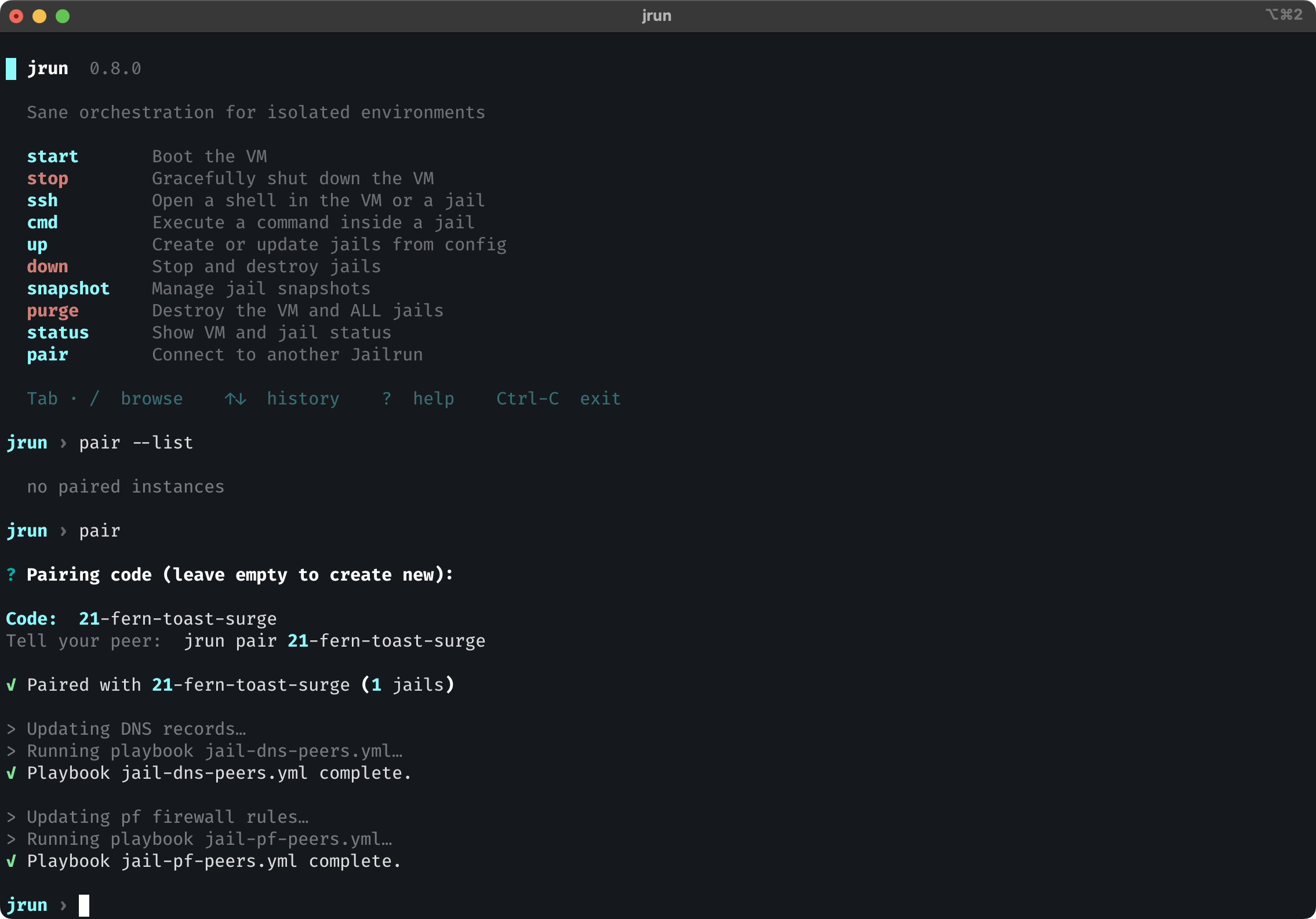
Create a pairing on one side and share the code with your peer:
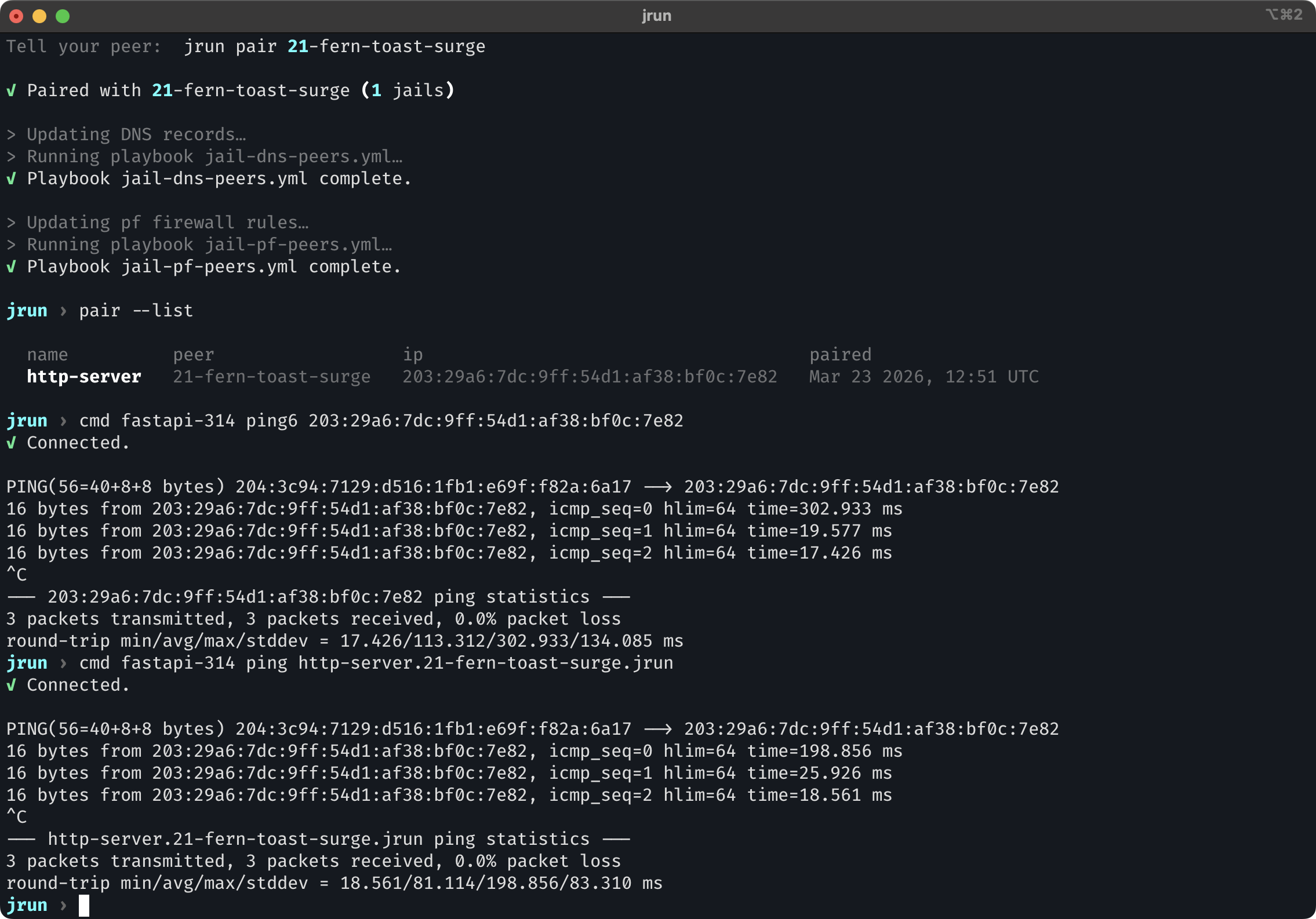
Once the handshake completes, jails on both sides can reach each other directly by IPv6 address or by fully qualified name:
To tear down a pairing and revoke all access: